Practical Packaging Guide
Prepared by Hongsen Packaging Team, sharing practical material and custom-processing guidance from our packaging manufacturing experience since 2002.
Fruit and eggs are easily marked, bruised or cracked when individual items touch, shift or carry concentrated pressure. Protective packaging should separate each item, support it without an unnecessarily tight fit and work with the crate or carton used for transport. Foam nets, trays and inserts provide different levels of organization.
Selection depends on produce size, shape variation, packing density and the way cases are handled. Food-contact and regulatory requirements must be confirmed for the intended market and order; they should never be assumed from the material name alone.
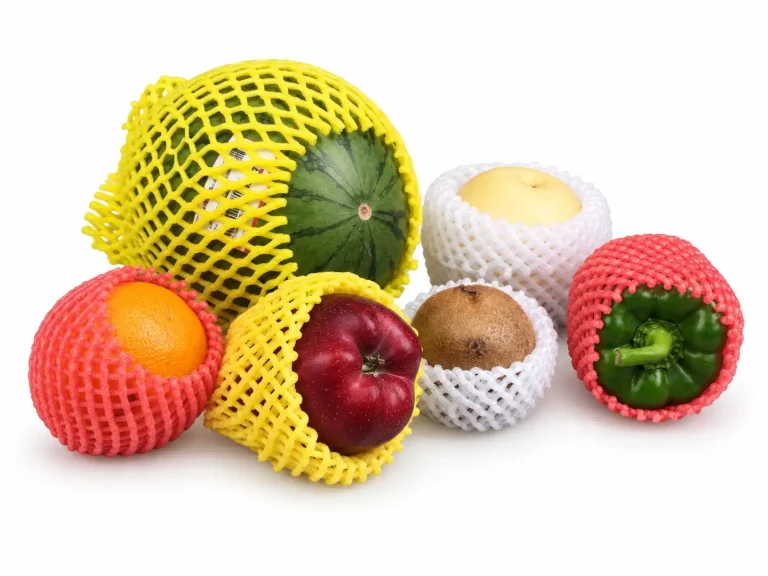
Foam nets for individual fruit
EPE fruit foam net sleeves wrap individual fruit with a flexible open structure. They are useful when pieces vary slightly in size and need separation during packing. Sleeve diameter, length and ease of application should be checked on the real produce.
A sleeve does not fix loose movement in an oversized case. Fruit arrangement, dividers and the outer package still determine whether pieces collide or carry stack pressure. Packers should test how quickly sleeves are applied and whether they remain in place.
Trays and inserts organize positions
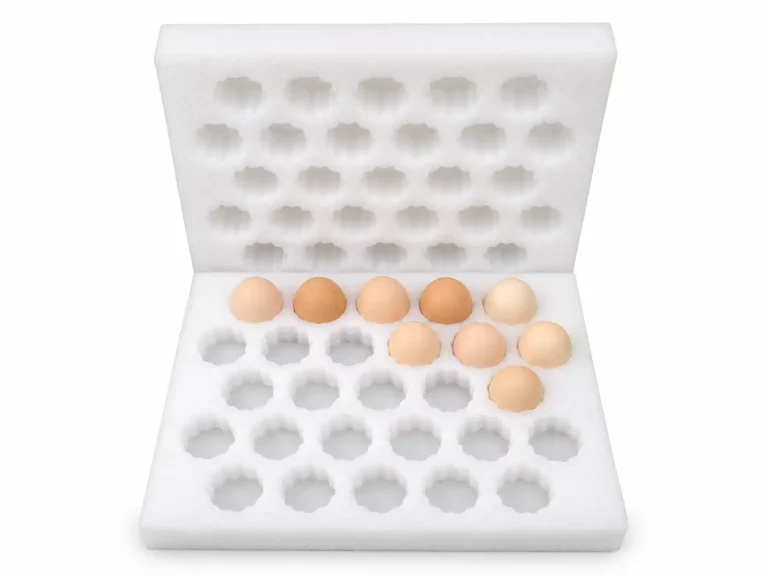
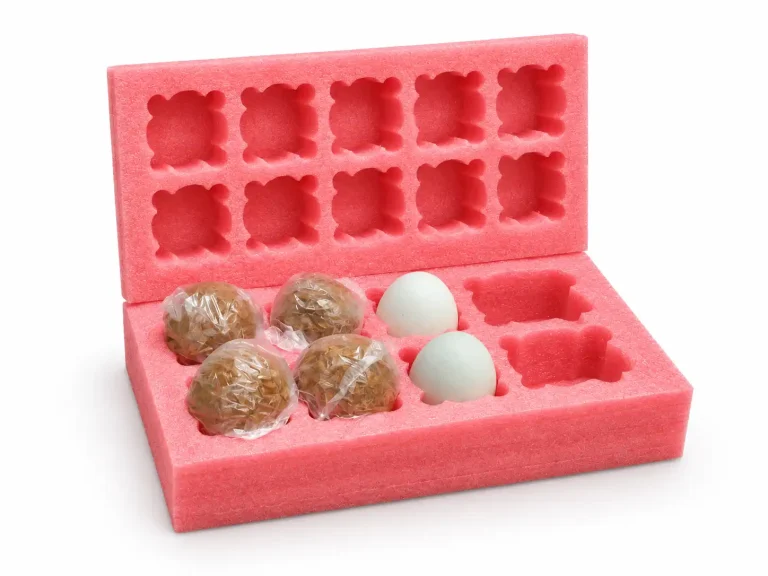
EPE foam egg trays and custom fruit inserts create defined positions. They suit repeated sizes and packing counts where orientation and separation should be consistent. Cell shape must be matched to the product rather than selected from appearance.
A tray should support without creating harmful pressure points. Check insertion, removal, lid or upper-layer clearance and the effect of stacking several trays. Shape variation in natural products makes sampling especially important.
Quick selection guide
| Format | Best starting use | Main check | Outer-pack question |
|---|---|---|---|
| Foam net sleeve | Individual fruit separation | Diameter, length and retention | Can the fruit still move? |
| Egg tray | Repeated egg sizes and counts | Cell fit and stacking clearance | Does the case support the tray? |
| Custom insert | Defined fruit or mixed produce layout | Contact points and removal | Is the arrangement repeatable? |
| Combined pack | Several separation needs | Layer order and pressure | What happens when stacked? |
Fit, handling and packing-line checks
Measure several representative pieces, not only one ideal sample. Record the practical size range and identify unusually shaped produce. Test the smallest and largest items in the same proposed sleeve or cell.
Review ventilation, condensation and storage conditions with the full packaging system. The article does not establish food-contact suitability or shelf-life performance; buyers should state the destination market and required documentation during enquiry.
Common mistakes
- Choosing a sleeve from one fruit sample without checking size variation.
- Packing trays tightly enough to create pressure at contact points.
- Assuming individual sleeves prevent movement inside a loose outer case.
- Stacking trays before checking upper and lower clearance.
- Assuming food-contact compliance without requesting applicable documentation.
What to send with an enquiry
Provide produce type, size range, photographs, packed count and outer-case dimensions. Explain whether items are sleeved manually, placed in trays or arranged in several layers. Include current damage photographs when available.
State the destination market and any required material or food-contact documentation. Hongsen Packaging can review egg and fruit foam packaging from samples or agreed dimensions.
A practical approval process
Review the requirement, agree a starting construction and test a sample with the real product and outer packaging. Ask the people who perform the packing to check insertion, orientation, closure and movement. Record the approved dimensions, layer order and any artwork or handling instructions so that repeat orders refer to the same pack rather than to memory.
If the product, carton, accessories or transport method changes, repeat the relevant checks. Packaging is a system: a small dimensional change can alter fit, contact pressure and empty space. A controlled sample and clear specification provide more useful evidence than a broad promise about material performance.
Frequently Asked Questions
Should every fruit use the same net size?
Only if the practical size range fits comfortably. Test representative small and large pieces before confirming a sleeve.
Can trays be stacked?
They may be designed for layered packing, but cell fit, upper clearance and the outer case must be tested together.
Do foam nets stop all movement?
They separate surfaces but do not automatically restrain the complete load. Case fit and arrangement remain important.
Is food-contact compliance automatic?
No. State the market and documentation requirements so the applicable material and order can be reviewed.
Discuss your packaging requirement
Planning fruit or egg packaging?
Send representative sizes, packing count, outer-case details and required documentation. We can help compare sleeves, trays and custom inserts.
Share the product details first so the recommendation can be based on the actual packing task.
Need help with a packaging requirement?
Share your product dimensions, transport conditions and order quantity. We will help clarify the next step.