Practical Packaging Guide
Prepared by Hongsen Packaging Team, sharing practical material and custom-processing guidance from our packaging manufacturing experience since 2002.
Inflatable packaging covers several formats that look similar before inflation but behave very differently around a product. Air column bags create a connected structure around an item. Air column roll material can be converted or wrapped for changing sizes. Air pillow film produces individual cushions mainly used to manage empty space inside a shipping carton. Selecting the wrong format can leave the product free to move or make the packing process unnecessarily complicated.
The comparison should begin with the product and carton, not with the appearance of the uninflated film. This guide explains the decisions an industrial or e-commerce buyer should make before requesting a sample. Inflation settings, film construction, dimensions and final pack performance still need to be confirmed for the actual order.
Three formats, three different jobs
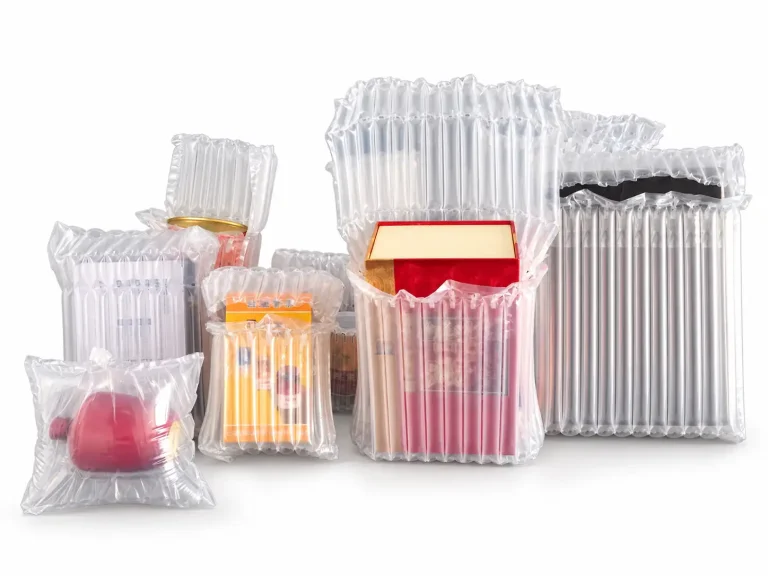
Air column bags surround a defined product
Custom air column bags are formed around a repeated product shape. Once inflated, the columns create a protective envelope that can separate the item from the carton walls. This format is a useful starting point for bottles, electronics, instruments and other products that benefit from coverage on several sides.
A bag depends on fit. A large gap lets the product move inside; an overly tight opening makes insertion difficult. Buyers should provide the maximum product dimensions, note projections and identify which end must remain accessible. The inflated bag and the outer carton must be checked together.
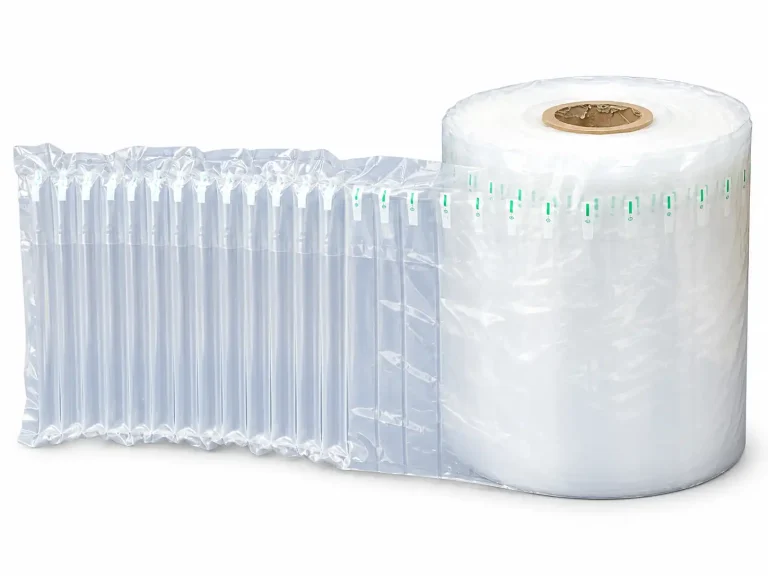
Air column rolls support flexible conversion
Air column cushioning rolls provide a longer format that can be cut or converted for products of different lengths. They suit operations that need inflatable cushioning but do not want a finished bag for every variation. The packing method must define where the roll starts, overlaps and is secured.
Roll material offers flexibility, but operator consistency matters. If every packer uses a different length or inflation level, the final packages will differ. Marked cutting lengths, a simple work instruction and a tested carton arrangement make the format easier to control.
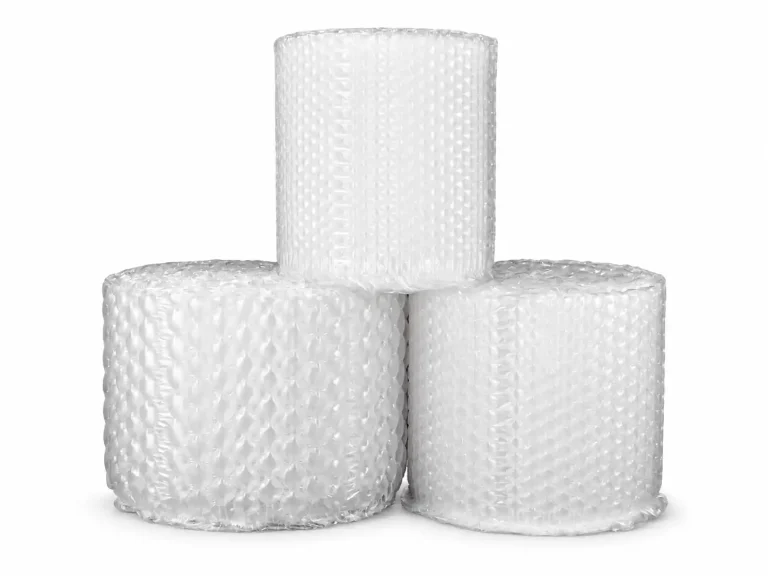
Air pillows fill unused carton space
Inflatable air pillow film is normally considered when the product already has primary protection but needs less movement inside the carton. Pillows can occupy top, side or corner voids without wrapping the product. They are practical for parcel fulfilment where carton sizes and order combinations vary.
Void fill is not the same as fitted cushioning. Pillows should not be expected to correct a carton that is far too large or protect an exposed fragile surface by themselves. Their job should be defined as restraint, separation or top fill within a complete pack.
Quick comparison
| Format | Primary role | Best starting condition | Critical check |
|---|---|---|---|
| Air column bag | Surround an individual product | Stable product size and repeated packing | Fit after inflation and carton clearance |
| Air column roll | Wrap or convert around changing lengths | Several related sizes or flexible production | Cutting method, overlap and restraint |
| Air pillow film | Manage empty space in a carton | Product already has primary protection | Pillow placement and product movement |
| Combined system | Separate and restrain | Several damage risks in one shipment | Every layer has a clear purpose |
Match the format to the failure mode
If previous damage is concentrated on the product surface or corners, start by reviewing fitted coverage. If the product remains intact but arrives shifted, the problem may be unused space or weak restraint. If accessories collide with the main item, separation is required. Photographs of the opened carton after transport can help distinguish these conditions.
Carton orientation is equally important. A bag that works upright may load differently when the parcel is placed on its side. Pillow placement can change when cartons are stacked or turned. Test the pack in the orientations that are likely during normal handling instead of judging it only on the packing table.
Inflation and packing control
An inflatable format must be assessed in its inflated state. The film width alone does not describe the final cushion. Equipment settings, valve design, column size and the space available in the carton influence the result. These variables should be confirmed with the supplier and recorded after the sample is approved.
Operators also need a repeatable sequence: inflate, inspect, insert or wrap, place in the carton and verify movement before closing. A slow or awkward step can become a bottleneck at volume. Trial packing should include the person who will perform the work, not only procurement staff.
Common mistakes
- Using air pillows as the only protection for a product with an exposed fragile surface.
- Selecting a finished bag without allowing for handles, caps, cables or other projections.
- Comparing uninflated film dimensions instead of the inflated package inside the carton.
- Leaving a large carton void and trying to correct it with a few loose cushions.
- Approving the material but not documenting inflation and packing instructions.
What to include in your enquiry
Send the product dimensions and weight, photographs from several angles, the outer-carton internal dimensions and the packed orientation. Identify fragile areas and explain whether damage is caused by impact, rubbing or movement. State the expected order quantity and the number of product sizes that must share the same packing operation.
If an inflation machine is already in use, describe the equipment and current consumable format. If not, explain the desired packing rate and available workstation space without assuming a machine specification. Hongsen Packaging can review the application and discuss a sample based on the available inflatable packaging formats.
Frequently Asked Questions
Are air column bags and air pillows interchangeable?
No. A column bag is generally fitted around a product, while pillows mainly manage unused space. They may be combined, but each should have a defined job.
Can one air column bag fit several product sizes?
Sometimes, when the dimensions and shape are close. Fit and insertion must be tested because excessive space or pressure can make the solution unreliable.
Do air pillows replace inner cushioning?
They can restrain an already protected product, but they should not automatically replace surface, corner or fitted cushioning for a fragile item.
What should be tested first?
Test the inflated format with the real product and final carton, then check insertion, movement, closure and likely package orientations.
Discuss your packaging requirement
Need to compare inflatable packaging formats?
Share the product, carton and current packing problem. Hongsen Packaging can help identify whether a bag, roll, pillow or combined sample is the right starting point.
Share the product details first so the recommendation can be based on the actual packing task.
Need help with a packaging requirement?
Share your product dimensions, transport conditions and order quantity. We will help clarify the next step.